

Risk Management · 2025
In this section4 topics
Risk Management Policy & Plan
Policy & Plan Description
Risk Management and Business Continuity Management Policy
Due to complex and rapidly changing business environment and the crisis natural disasters which may affect the ability to achieve the goal to drive the organization for sustainable successes, risk management and business continuity management are an important process that helps the Company to handle business uncertainty systematically, to create business potential, to increase business opportunities, and to support the achievement of short-term, medium-term and long-term organization's goals as well as to build confidence and credibility to stakeholders. Please see more information in website;
Risk Management Policy https://www.sritranggroup.com/storage/downloads/cg/important-policies/20260211-sta-risk-management-policy-en.pdf
Business Continuity Management Policy https://www.sritranggroup.com/storage/downloads/cg/important-policies/20260211-sta-business-continuity-management-policy-en.pdf
The Company has a risk management structure consisting of the Board of Directors (BOD), responsible for overseeing the efficiency of risk management framework and appointing the Risk Management Committee (RMC), The chairman is the company's board of directors, responsible for determining the policy and framework as a guideline for practice among Sri Trang’s group including supervision and support for risk management and business continuity management in various aspects to succeed at the overall organization, business unite and project levels. In addition, the RMC also sets up a Risk Working Group (RWG), consisting of executives from several departments, which is responsible for following-up risk management operations regularly to comply with the policy, objectives, risk appetite, and operate by the Risk Management Department, is an independent unite that is not under any business line and the Risk Management Head is not a same person with the Internal Audit Head, responsible for overseeing standards, analyzing, and monitoring risk management in various areas., the risk management framework approved by the Risk Management Committee. Moreover, the RWG’s responsibility is to promote and cultivate employees at all levels to understand the importance of risk management and to be able to bring risk management concepts in practices to create as a corporate culture.
Risk Management Structure
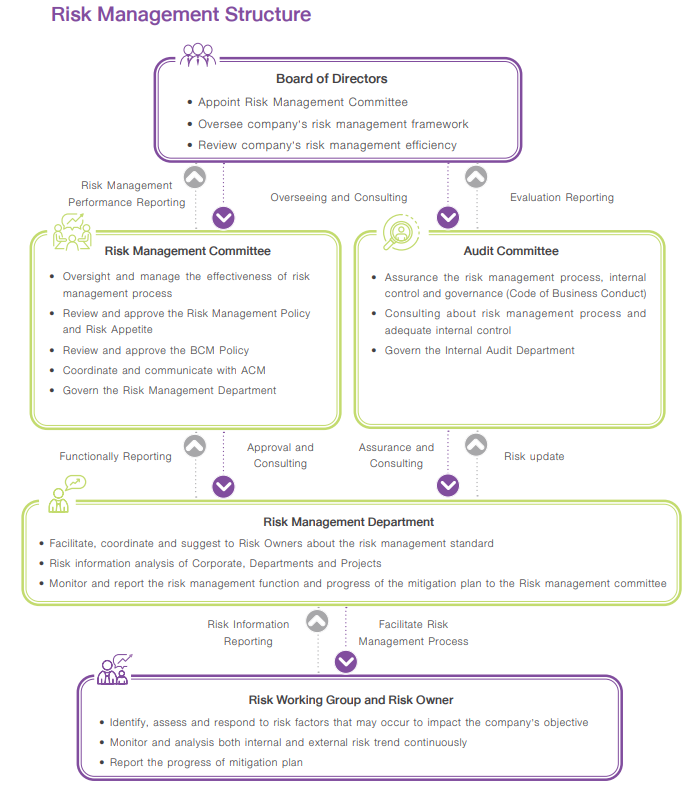
In addition, to increase management flexibility and align with business operation in various environments, the Company has established risk management at the level of business groups/lines or specific committees, for example;
Regulatory Affairs Committee is responsible for effectively considering, controlling, managing, communicating, and providing information to government entities in the same direction without any conflicts and to comply with laws and regulations.
Working Team for Complying with Personal Data Protection Act is responsible for ensuring work plans, guidelines, and practices to be complying with the Personal Data Protection Act.
Sustainable Development Committee is responsible for conducting work plan and governing the Company’s operations to be following the organization’s sustainable development policy which cover environment, social and governance dimensions.
The Company has implemented a risk management system in accordance with international standards, COSO (The Committee of Sponsoring Organizations of the Treadway Commission) or ERM COSO (2017) and Business Continuity Management (ISO 22301:2019) to be applied along with several standards involved in the business. The Company has paid attention to manage 4 key risk factors namely strategic risks, operational risks, financial risks, and compliance risks as well as other emerging risks, ESG risk and project investment risks in each time horizon (Short term (1-3 year), Medium term (>3-5 year) and Long term (>5 year) that may affect the achievement of the vision, mission, objectives, and goals of the Company, in case there is any improper management. Moreover, there is KRIs as a monitoring tool and evaluate risk status for preparation of contingency plans in a timely manner and promote a risk management culture by reviewing risk information at least once a quarter and reviewing the risk management policy and plan annually. Moreover, learning materials and quizzes were provided through an e-learning system for executives and employees to study and review the annual risk management process. By 2025, all executives and employees have completed the study and passed all quizzes (100%). Please see more information of the risk management committee performance and responsibilities in the Annual Report 2025
The Company has established the Business Continuity Management for high-risk disaster situations that may occur to factories covering all factories and product groups of the Company nationwide (STR,LTX,RSS), including planning rehearsals from assessing the likelihood of disasters occurring in each area to ensure that the strategies are ready for actual use and are aware of any limitations that may occur before disasters actually occur. In 2025, the Company conducted 8 time of BCP exercises at plants and handle the Business Continuity Plan in response to the flooding and unrest in border areas enabled the company to maintain business continuity without significant impact on customers and stakeholders.
In 2026, the Risk Management Committee set the goal to manage the Company’s risk management to be efficient and effective under the changing business strategies. This is to ensure that the risk management is adequate, being implemented continuously, and be able to control the risk in acceptable level, enabling the company to achieve the goals and being able to add value to the company as well as delivering the maximum benefits to shareholders and stakeholders of the company fairly and sustainably.
Policy Document Link
https://www.sritranggroup.com/en/cg/important-policies
Risk Factors — Overview
Risk Factors — Introduction
Risk Assessment, Risk Prioritize and Monitoring Change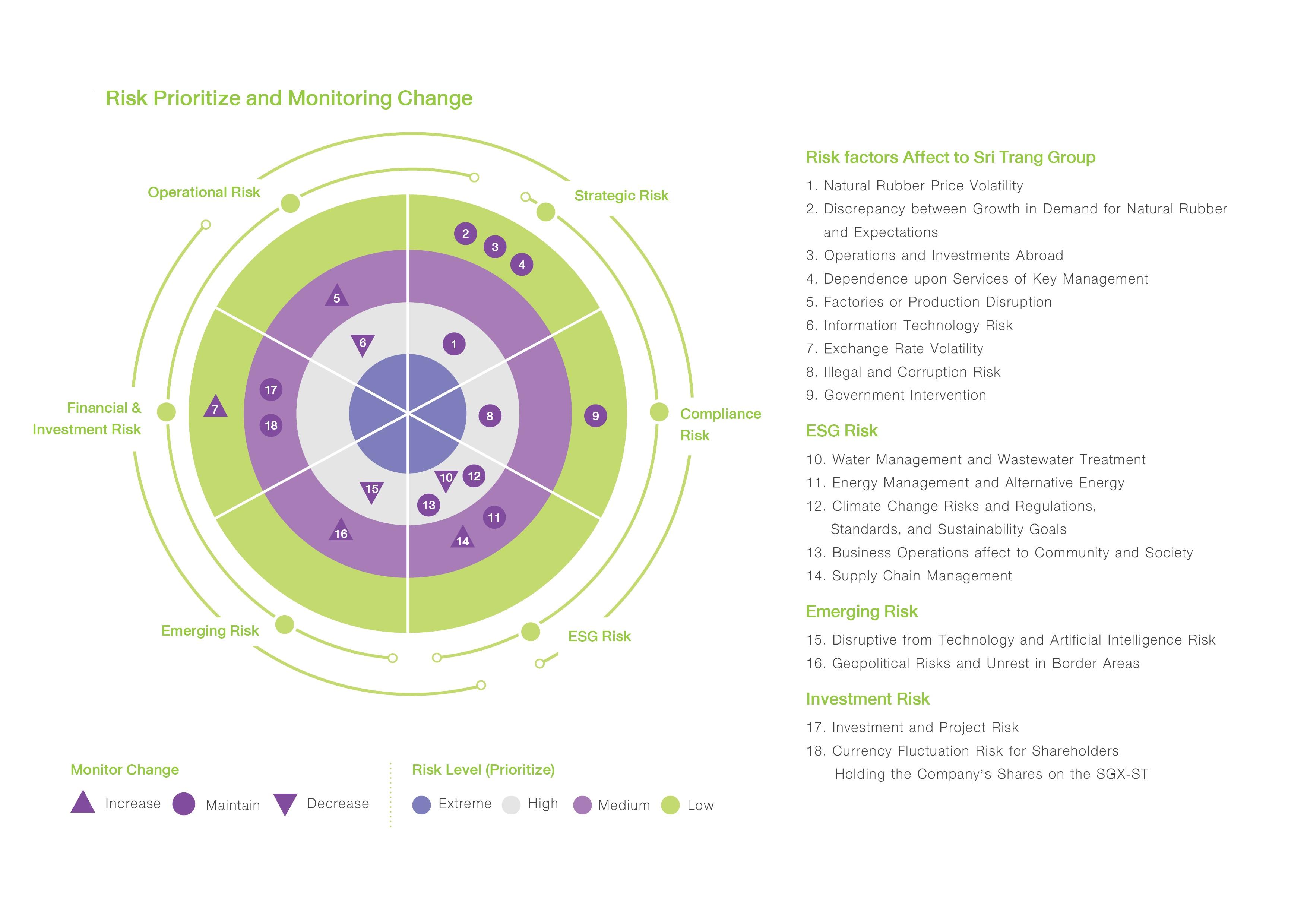
Risks to the Company's Business Operations
Risk Register
| Risk Name | Risk Characteristics | Consequences | Management Measures | Related Risk Factors |
|---|---|---|---|---|
| Strategic Risk: Natural Rubber Price Volatility | Risk Description and Causes: The Commodities includes natural rubber, which tends to have price fluctuations. which entrepreneurs in the natural rubber industry has limitations on harvesting time and changes in the price of natural rubber as mentioned. Factors, affect the price of natural rubber and natural rubber products sold by the company, are demand and supply of natural rubber, raw material price fluctuations, prices of crude oil, energy, oil-based chemicals and speculation in trading in the futures market (Commodity Future Exchange)
| Impact Analysis:
| Risk Mitigation Plan: The Company has a policy to manage risks arising from fluctuations in the price of natural rubber both managing the process of acquiring raw materials in quantity and price, expanding raw material purchasing centers and production to various regions of the world (Global source) such as Cote d'Ivoire (Ivory Coast), along with using natural rubber trading contracts in the futures market and with product delivery, the contracts will be fair value as of the reporting date in the financial statements. In addition, the Company has implemented hedging accounting to reduce the impact of changes in fair value due to changes in the price of natural rubber. (Please find more details in Notes to Consolidated Financial Statements under item 4.21 and 36.1) | 728 · Description: Volatility in the industry in which the company operates · Info category: STRATEGIC_RISK · 1715 · Description: Economic risk · Info category: STRATEGIC_RISK |
| Strategic Risk: Discrepancy between Growth in Demand for Natural Rubber and Expectations | Risk Description and Causes: The natural rubber and rubber gloves are products that are in demand from a wide variety of user groups in countries around the world. As a result, the amount of consumption demand and market expansion can change from many factors whether there are consumption behavior, trends, substitute products, changes in technology as well as rules and regulations, experiment in order to replace natural rubber in the event that the price of natural rubber increases. And the Food and Drug Administration (FDA) and in some country’s announcement prohibiting the use of powdered rubber gloves in medicine, etc.
| Impact Analysis:
| Risk Mitigation Plan: The Company is closely aware of changes that may affect the demand for consumption of natural rubber and rubber gloves and plan to manage risks to minimize the impact. For the natural rubber products, the company has produces rubber products, namely TSR, RSS, and LTX that have various usage characteristics according to customer needs, helping to alleviate risks that may arise from specific customer groups. In addition, the company has diversified risk by vertically integrated business model also allows us to against a negative impact on any part of our operations. Rubber Glove Products, the company manages such risks starting from our machinery can produce both latex and nitrile gloves, which allows us to timely adjust the proportion of glove production. We also have a variety of customer bases that have varying preferences and regulations. Our production and marketing strategies can be timely adjusted to respond to changing market demand. | 729 · Description: Behavior or needs of customers / consumers · Info category: STRATEGIC_RISK · 1715 · Description: Economic risk · Info category: STRATEGIC_RISK |
| Strategic Risk: Operations and Investments in Foreign Countries | Risk Description and Causes: The company has operated and invested in many countries such as Thailand, Singapore, Indonesia, Vietnam, Myanmar, China, Philippines, Ivory Coast, and the United States. Therefore, the Company is exposed to risks associated in these countries from situations such as inflation, interest rate, economic conditions, insurgency military, conflict terrorism political, safety conditions, laws and regulations, import duties and other tariffs, natural disasters, foreign exchange bans or capital transfers or the seizure of private businesses or private property, etc.
| Impact Analysis:
| Risk Mitigation Plan: The company has assessed the risks and closely follow operations performance, environmental conditions, and changes in related laws and regulations both domestically and abroad to assess opportunities, obstacles, and guidelines for appropriate operations to reduce the negative impact that may occur on the company. | 731 · Description: Policies or international agreements related to business operations · Info category: STRATEGIC_RISK · 1716 · Description: New business risk · Info category: STRATEGIC_RISK |
| Strategic Risk: Dependence upon Services of Key Management | Risk Description and Causes: One important factor affecting the growth of the Company is the ability to recruitment, development and maintain the professional managements. Therefore, it depends on the Company's ability to retain key executives as well as develop and train new executives (Successor). If a member of experienced management team unable or unwilling to work in their position, the Company may not be able to find a suitable person to replace in appropriate time that may have a negative impact on the business. In addition, the process for recruiting new executives which must compete with other companies.
| Impact Analysis:
| Risk Mitigation Plan: The Board of Directors has appointed a Nomination Committee to recruit and search for qualified candidates who could potentially assume positions as the Company’s directors or executives to ensure that such persons will have the required knowledge, skills, and experience to carry out our business strategies. In addition, the company has established a personnel management process for important positions in the organization (Succession Plan), Including appropriate job rotation to ensure that the management have a variety of skills suitable for the positions, such as developing leaders according to the STA Development Program, creating a performance evaluation system and compensation, which includes competitive benefits. as well as creating a career path system, etc. | 737 · Other name: Dependence upon Services of Key Management · Description: Other · Info category: STRATEGIC_RISK |
| Operational Risk: Factories or Production Disruption | Risk Description and Causes: The company's production requires a lot of necessary resources to the production factory can regularly operate. If there is a natural disaster, accident, epidemic, force majeure, labor or raw material shortage, disruptions in public utilities such as water supply, water recycle systems, electricity, IT and any other catastrophic by human or natural events or events beyond the control of the company It can lead to disruptions or significant interruptions in operation business.
| Impact Analysis:
| Risk Mitigation Plan: The Company has in place a business continuity plan (BCP) to ensure continuity of the Company’s operations in the event of a contingency or any unforeseen circumstances that could disrupt the operations. However, having such plan in place merely ensures that the operations would continue, and any damage would be minimal. It does not necessarily mean that the operations would continue to run as smoothly as they would under normal circumstances. In addition, the Company has industrial all risks insurance to protect the business from any loss or damage that might result from a natural disaster or any unforeseen circumstance, as well as business interruption insurance to minimize the financial impact that could result from any disruption to operations. | 742 · Description: Human error in business operations · Info category: OPERATIONAL_RISK · 750 · Description: Climate change and disasters · Info category: OPERATIONAL_RISK · 751 · Description: Impact on the environment · Info category: OPERATIONAL_RISK · 1720 · Description: System disruption risk · Info category: OPERATIONAL_RISK |
| Operational Risk: Information Technology Risk | Risk Description and Causes: In a rapidly changing business environment, the company continuously adopts innovative digital technologies to enhance operational efficiency and prepare its skilled workforce to create business opportunities and adapt to future changes. Examples include the use of the SAP system, the implementation of the “SRI TRANG FRIENDS” application to facilitate the purchase of natural rubber from partners nationwide, and the application of Artificial Intelligence (AI) and the Internet of Things (IoT) in operational processes and data management. However, increased reliance on digital technology, automation, and network connectivity may pose IT risks and cybersecurity risks. These include unauthorized access, inaccuracies or discrepancies in data used in AI processing, risks from IoT devices connected to the network, and system failures that could disrupt business operations. These risks could impact the company's business continuity, reliability, image, and reputation. Furthermore, these risks affect the confidentiality, integrity, and availability of the company's data and information systems—critical factors for business continuity, stakeholder trust, compliance with the Personal Data Protection Act (PDPA), and adherence to relevant standards.
| Impact Analysis:
| Risk Mitigation Plan: The company recognizes the risks associated with information technology and cyber threats, covering key areas such as 1) Risk Assessment and Prevention (Identify/Protect): Policies for managing various information technology risks are in place and communicated via intranet to all management and employees for their awareness and implementation. This includes penetration testing and vulnerability assessment. 2) Incident Detection and Response (Detect/Respond): Monitoring, investigating, and alerting to abnormal cyber behavior, and implementing an information security incident management system. 3) Business Recovery and Continuity (Recovery): A disaster recovery site and emergency response plan are in place, including ongoing drills to address unforeseen events. Furthermore, the company continuously raises cybersecurity awareness among employees through email newsletters and annual training to encourage greater caution in the use of information systems. | 744 · Description: Information security and cyber-attack · Info category: OPERATIONAL_RISK · 1720 · Description: System disruption risk · Info category: OPERATIONAL_RISK |
| Financial Risk: Exchange Rate Volatility | Risk Description and Causes: While our financial report is shown in Thai Baht, our raw materials purchasing for natural rubber products are transacted in Thai Baht and Indonesian Rupiah, and our raw materials purchasing for gloves are transacted in Thai Baht and U.S. Dollar. However, approximately 73.7 percent of our total revenues is denominated in U.S. Dollars. (approximately 22.9 percent of our total revenues is denominated in Thai Baht.) Therefore, the fluctuations in the exchange rates between Thai Baht, Indonesian Rupiah, U.S. Dollars, or other currencies, could adversely affect our business, financial position, and operating results. Any fluctuations in the exchange rates between Thai Baht, Indonesian Rupiah, and Malaysian Ringgit could adversely affect our price competitiveness to other natural rubber and glove producers from Indonesia and Malaysia, respectively.
| Impact Analysis:
| Risk Mitigation Plan: The Company has attempted to mitigate foreign exchange risks by using financial derivatives to hedge our foreign exchange exposure arising from the purchase and sale of products in currencies other than Thai Baht. Such derivatives are recorded at their fair value on the date of the statement of financial position. In addition, the Company has adopted cash flow hedge accounting in order to reduce the effect of changes in fair value due to exchange rate movement. (Please find more details in Notes to Consolidated Financial Statements under item 4.21 and 36.1.) | 764 · Description: Fluctuation in exchange rates, interest rates, or the inflation rate · Info category: FINANCIAL_RISK |
| Compliance Risk: Illegal and Corruption Risk | Risk Description and Causes: The group of companies operate comply with the law and regulations both within Thailand and abroad, the Company must comply with laws and regulations in many countries. Therefore, failure to comply or comply with the laws, regulations, and policies of each country as well as corruption, it may affect the reputation of the company and lead to punishment and fines or loss of business opportunities. The legal process can be taking a long time and expensive. It is also possible that these regulations and/or social practices may be more strictness in the future.
| Impact Analysis:
| Risk Mitigation Plan: The Company has established a business unit that is responsible for monitoring and controlling the amendments of the relevant laws and regulations, including assessing and monitoring risks related to fraud within the organization. The unit will then analyze the impacts on the Company’s operations and communicate to the managements and related business units to ensure that the Company will be able to conduct the business in compliance with the relevant laws and regulations. In addition, the Company has determined regulations and various schemes to ensure compliance with the relevant laws and regulations, such as the Good Corporate Governance and Business Ethics Policy, the Anti-Corruption Policy, and the whistle-blower system as well as the annual review of compliance and regulations, etc. | 756 · Description: Change in laws and regulations · Info category: COMPLIANCE_RISK · 757 · Description: Laws and regulations is not favorable for doing business · Info category: COMPLIANCE_RISK · 758 · Description: Violations of laws and regulations · Info category: COMPLIANCE_RISK |
| Compliance Risk: Government Intervention | Risk Description and Causes: When the rubber price falls to low level, government and related organization might implement intervention measures such as decreasing the natural rubber export quota to ease the drop in natural rubber price or purchasing rubber and manufacturing it through partner. However, the measures implemented may cause domestic natural rubber prices to be inconsistent with prices in the global markets or may cause the Company’s sales volume to be inconsistent with market demand, which may impact the cost structure, revenue, and profit of the Company and industry.
| Impact Analysis:
| Risk Mitigation Plan: The Company carefully manages its operations under the prevailing circumstances, taking account of the intervention by the Government or any other authorities. Having production facilities located in different strategic locations, both domestically and internationally, also enables us to maintain our competitiveness in the global market. | 760 · Other name: Government Intervention · Description: Other · Info category: COMPLIANCE_RISK |
| Environmental, Social and Governance Risk: Water Management and Wastewater Treatment | Risk Description and Causes: In the current climate change, there is a physical acute risk that has a significant impact on water management because the lack of seasonal rain and there is no rain in the upstream area, so the amount of water stored in the dam decreased, eventually resulting in a drought crisis. Then the amount of water may not be sufficient for use within the factory and nearby communities if the Company lacks an efficient water use management process consistent with the amount of demand for use or lack of effective monitoring and inspection processes for the quantity and quality of water use will likely put the factory in a water shortage situation or is a Water-stressed areas
| Impact Analysis:
| Risk Mitigation Plan: The company has established a working group to monitor and report the situation of water use and storage within the factory on monthly, there is review and survey the area of the water reservoir plan, surface water sources and underground water source and recycled water source to determine the critical point and contingency plan for water use in each factory. In 2026, the company has set a goal to reduce water use by 20 percent compared to the base year 2022. The company has organized training course “Smart water management for sustainable development” by experts with specific expertise to encourage employees to know and aware of water conservation and prepare for the El Nino situation and manage water from all sources efficiently. To monitor the operational efficiency, we develop a shallow groundwater recharge system under “Shallow Groundwater Recharge Industry Project” of the Groundwater Development Fund Department of Groundwater Resources and the Federation of Thai Industries to encourage to use vacant space within the factory for development as a source for collecting rainwater and adding to the shallow groundwater level. | 750 · Description: Climate change and disasters · Info category: OPERATIONAL_RISK · 1717 · Description: ESG risk · Info category: STRATEGIC_RISK · 1719 · Description: Climate change and disasters · Info category: STRATEGIC_RISK |
| Environmental, Social and Governance Risk: Energy Management and Alternative Energy | Risk Description and Causes: Energy is important element in the operations and an important cost to the Company's performance. At the same time, the energy creates a continuous physical risk to the environment from the release of greenhouse gases from energy using in the production process if the company does not set strategies for energy management and choosing appropriate alternative energy, including developing innovations that help reduce energy use operations processes. It may cause higher costs and negative impacts on the environment.
| Impact Analysis:
| Risk Mitigation Plan: The company studies, develops, and improves efficiency in the production process. Planning to maintenance of machinery so that production can be carried out at full efficiency under appropriate energy use or modifying machinery to be energy-saving equipment, such as using a Turbo Blower type aerator for the wastewater treatment system, it replaces the original Root Blower type aerator, it more energy efficient and efficient in waste treatment. The company also has a project to produce electricity from solar energy on a floating buoy (Solar Floating) and Solar Farm, it is a clean and renewable energy to reduce the use of fossil energy and greenhouse gas emissions. In 2025, the company has invested more than 115 million baht to implement the clean energy project. | 1717 · Description: ESG risk · Info category: STRATEGIC_RISK · 751 · Description: Impact on the environment · Info category: OPERATIONAL_RISK |
| Environmental, Social and Governance Risk: Climate-Related Risks, Regulations, Standards, and Sustainability Goals | Risk Description and Causes: Climate Change, caused by global warming, is one of the environmental risks (Climate-Related Risk) that impact to the Company's business in 2 dimensions.
| Impact Analysis:
including financial impacts, property and employee safety. In 2025, the Company was affected by flooding at 5 factories, initial estimated value of financial impact from loss of property, buildings, machinery, equipment and inventory is 80-90 million baht. The Company has claimed compensation for the damage from the insurance company, so it did not have a significant impact on the Company's overall performance.
Analysis of situation trends: The Company has monitored fluctuations that have a significant impact on business operations and conducts business sensitivity analysis by considering internal and external factors, both financial and non-financial factors through the models to assess changes in results the values of variables or elements in the analysis and determines a strategic plan to cope by monitoring and reviewing the situation and related factors regularly. Please see more information at website: https://www.sritranggroup.com/en/investor-relations/financial-information/sensitivity-analysis-summary | Risk Mitigation Plan and Opportunity: The Company has set and implemented strategies to manage risks and opportunities from temperature changes to reduce impacts in various aspects as follows: Physical Risk
Transition Risk
Opportunity Analysis: The company is still committed to research and develop innovations and new production knowledge under environmentally friendly technology to reduce energy usage with reasonable production costs and reduce greenhouse gas emissions, including upstream business operations that are certified for amount of greenhouse gases reduced/absorbed (carbon credits). The Companies whose greenhouse gas emissions still exceed the standard still desire to purchase carbon credits to compensate for the portion of their greenhouse gas emissions. | 756 · Description: Change in laws and regulations · Info category: COMPLIANCE_RISK · 1717 · Description: ESG risk · Info category: STRATEGIC_RISK · 751 · Description: Impact on the environment · Info category: OPERATIONAL_RISK · 1719 · Description: Climate change and disasters · Info category: STRATEGIC_RISK |
| Environmental, Social and Governance Risk: Business Operations may disrupt the Community and Society | Risk Description and Causes: Due to the Company Operate a production that may have environmental issues or affect to stakeholders, this may be complained from communities or government on issues, such as waste management remaining from the production process, management of water, air, odor pollution, environmental claims regarding the destruction of ecosystems or biodiversity, Human Rights Due Diligence, non-discrimination and inequality, occupational health and safety in the work area. In the future, rules and/or social practices may change or become stricter.
| Impact Analysis:
| Risk Mitigation Plan: The company has migrated environmental and social risks through the ISO 14001 environmental management system and ISO 45001 Occupational Health and Safety management by analyzing the organizational context (SWOT), including the expectations of stakeholders to identify and assess risks that may affect the company. The assessment can be classified as follows:
| 1723 · Description: Legal risk · Info category: COMPLIANCE_RISK · 1717 · Description: ESG risk · Info category: STRATEGIC_RISK · 751 · Description: Impact on the environment · Info category: OPERATIONAL_RISK |
| Environmental, Social and Governance Risk: Supply Chain Management | Risk Description and Causes: The company is the world's largest fully integrated producer and distributor of natural rubber (Midstream), which must be operated jointly with many external partners, therefore we need to rely on efficient supply chain management to ensure continuity in the delivery of main raw materials for production (Upstream), including raw rubber sheets, cup lump and field latex. If the company lacks a proper process, such as relying on a single or large rubber raw material trader, business ventures and cultivation that affect the environment or violate laws such as the EU Deforestation Regulation (EUDR) law or there is a conflict of interest between raw material traders and company representatives, or failure to comply with the customer's trade terms (Downstream), it will make the company force with higher risks in supply chain management.
| Impact Analysis:
| Risk Mitigation Plan: The company is aware the importance of effective supply chain management. Therefore, a fully integrated business model has been established from upstream, midstream to downstream, allowing the company have a variety of main products, including RSS, TSR, LTX and gloves, which diversify risk of the customer group. In 2025, no single customer who is not a related person accounted for more than 7 percent of our total sale volume of natural rubber products and 7 percent of our total sale volume of gloves. In addition, raw material management, the company has a strategy to build procurement network and set up production plants scattered in the southern, northern and northeastern, as well as expanding raw material purchasing centers and production to various regions of the world (Global source) such as Africa, Indonesia and Myanmar to ensure continuity of raw materials and production processes. Supplier Relationships Management, increase the number of rubber raw material traders and control amount of purchases per person to prevent monopoly or reliance on large trader. Internal audit process that controls and prevents conflicts of interest between raw material traders and company’s representatives. The company is also able to trace back the source of rubber raw materials (Traceability) by setting up a working group to design and determine measures, such as a retrospective inspection system, tracking the process of each product and preparation for data reporting to ensure that the company and business partners do not carry out actions that affect the environment or commit illegal acts. | 733 · Description: Business operations of partners in the supply chain · Info category: STRATEGIC_RISK · 1717 · Description: ESG risk · Info category: STRATEGIC_RISK |
| Emerging Risk: Disruptive from Technology and Artificial Intelligence Risk | Risk Description and Causes: Nowadays, the rapid innovation and technological change (Disruptive Technology and AI) is more influence because business uses new technology to increase efficiency in various operations and make competitive potential, so it necessary for entrepreneurs to adapt, including the quality of products, services, and the knowledge and abilities of personnel to keep up with the change. The advancement of technology is beginning a greater role in the natural rubber industry especially the production technology that allows entrepreneurs have lower costs in the long run, make a competitive advantage from being able to set low selling price, and reduce amount of unskilled labor that replaced by technology, which may cause widespread impacts. However, the development of technology in the Company still considers the impacts on the environment, community and society.
| Impact Analysis:
Analysis of situation trends: The Company has monitored the progress of technology and innovation in manufacturing of both domestic and global industries (Megatrends), including other economic risk factors, along with appropriate resource allocation and the rate of return, in order to provide important information for investment decision-making. | Risk Mitigation Plan: The company has a continuous plan for innovation and technology development in production to increase efficiency in competition (production efficiency and cost reduction) along with establish a good regulatory structure for IT and AI Governance under the principles of promoting sustainability and being environmentally friendly and added value for products. The Company also develop the employee to keep up with technological changes, including skill development, general knowledge, and specialized knowledge along with creating awareness of social and environmental responsibility. Opportunity Analysis: The Company has studied and researched new projects with a determination to develop innovation and technology potential related to production processes to cover all product groups of the Company (RSS, TSR, LTX) to meet customer needs and sustainable environmental management leads to increased opportunities and competitiveness | 728 · Description: Volatility in the industry in which the company operates · Info category: STRATEGIC_RISK · 732 · Description: Changes in technologies · Info category: STRATEGIC_RISK |
| Emerging Risk: Geopolitical Risks and Unrest in Border Areas | Risk Description and Causes: Conflicts in border areas have a domino effect on businesses, particularly risking the safety of employees working or residing in conflict-prone areas. This can cause stress and demoralize employees when faced with emergencies requiring urgent evacuation or relocation, potentially leading to loss of life or property. Other risks include disruptions to factory production in affected areas, logistics and supply chains, labor shortages in border areas, and impacts on confidence in trading partners.
| Impact Analysis:
Analysis of situation trends: Border conflicts remain fragile and uncertain, meaning the company must continue to prepare for volatility. Access to labor from conflicting countries may not recover immediately, impacting the labor market in the long term and necessitating the selection of workers from other countries. Preparation for potential emergencies is also crucial. | Risk Mitigation Plan: The company has established policies and business continuity plans, including emergency management, communication, and evacuation plans in case of unrest in border areas. Drills are conducted based on assessments of potential incidents in each area to ensure the readiness and effectiveness of management strategies, and to identify potential limitations before actual events occur. A crisis management strategy is also in place under the direction of senior management (War Room). Opportunity Analysis: As one of the world's largest producers and exporters of rubber, with a complete supply chain encompassing rubber plantations, processing plants, and exports to diverse markets, developing a robust business continuity system capable of effectively managing crises will enhance customer and stakeholder confidence. Furthermore, it allows for diversification strategies in raw material sources, production, and transportation, as well as ensuring the safety of employees and communities during crises. | 730 · Description: Government policy · Info category: STRATEGIC_RISK · 742 · Description: Human error in business operations · Info category: OPERATIONAL_RISK · 733 · Description: Business operations of partners in the supply chain · Info category: STRATEGIC_RISK · 749 · Description: Safety, occupational health, and working environment · Info category: OPERATIONAL_RISK |
Risks to Securities Holders' Investment
Risk Register
| Risk Name | Risk Characteristics | Consequences | Management Measures | Related Risk Factors |
|---|---|---|---|---|
| Investment and Project Risk | Investment, new projects, or new businesses of the company are always faced with a risk from improper resource management, inexperienced team or incorrect budget, complexity and uncertainty in the project structure, if there is a lack of good management, the project will not succeed as planned. |
| In addition to considering the consistency of corporate strategy and return on investment, project investment risk management is another crucial component of business success. Therefore, every investment project must have a systematic risk analysis by the relevant business unit in each field and shall be considered and approved by the Board of Directors or related authorized personnel in order to ensure that the projects are implemented in accordance with defined plans and goals, and not affect the community and the environment. | 769 · Other name: Investment in New Project Risk · Description: Other · Info category: HOLDER_RISK |
| Risks to Investment in Our Shares | Currency Fluctuation Risk for Shareholders Holding the Company’s Shares on the SGX-ST. The Company’s shares traded on the SGX-ST are denominated in Singapore Dollars, while dividends, if any, will be paid in Thai Baht. Shareholders who hold shares traded on the SGX-ST, therefore, bear currency risk arising from fluctuations of Singapore Dollars against Thai Baht. |
| In paying dividends to our shareholders of shares traded on the SGX-ST, the Company will set the convertible rate from Thai Baht to Singapore Dollars on the day nearest to the date of dividend payment to minimize the currency fluctuation risk. Note: There are some risks that may be unknown to the Company and other risks that the Company currently considers to be immaterial. These risks could have an impact upon the operations of the Company in the future. | 768 · Description: Return from investment of securities holder · Info category: HOLDER_RISK |